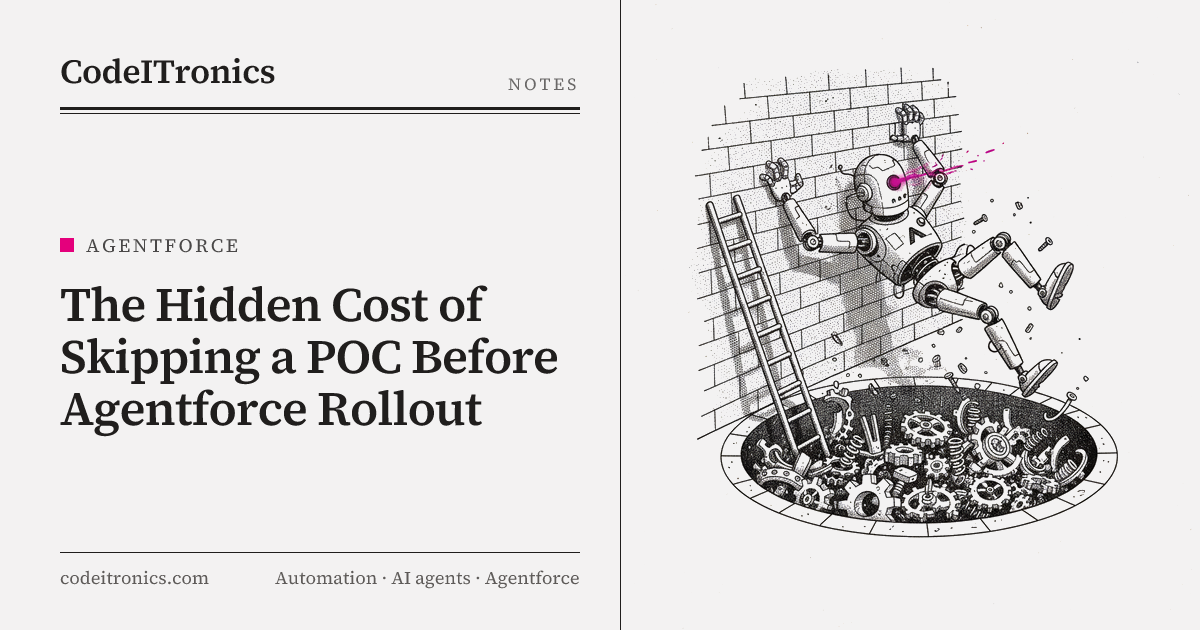
Skipping the proof of concept feels like saving time. The use case seems obvious, Agent Builder makes configuration look easy, and a POC sounds like a delay before the "real" project. But the cost doesn't go away. It moves to later, when it's more expensive, more visible, and harder to undo. This post covers the specific failure modes a POC catches early, the rework they cause when nobody catches them, and what a good two-to-four-week POC should actually prove.
What Skipping the POC Really Means
Teams rarely decide to skip validation outright. What usually happens is quieter. The pilot is scoped as "phase one of the rollout" instead of as an experiment. There are no pass or fail criteria, no test set, and no decision point. The agent goes straight from configuration to real users, and learning happens in production.
The result is that every assumption gets tested at the same time, in front of the people you most want to impress. When something goes wrong, it's hard to tell which assumption failed. Was it the data, the action, the topic design, or the use case itself? Rework then tends to be broad rather than targeted, because nobody isolated the cause.
A POC exists to test the riskiest assumptions one at a time, cheaply, before anyone outside the project depends on the answer. Each of the failure modes below is an assumption a POC would have tested.
The Agent Solves a Slightly Wrong Problem
The use case looked clear in a planning meeting: "let the agent handle return requests". In reality, a large share of what customers call "returns" are exchanges, warranty claims, or complaints about delivery, and each follows a different process. The agent was designed around the first category and keeps forcing the others into it.
A POC catches this in the first week, because building a real test set means pulling actual requests and labeling them. The mismatch between the planned use case and the requests that actually arrive shows up as soon as someone reads fifty real messages.
The rework when it's missed: redesigning topics after launch, which often means rewriting instructions and action mappings that other topics now depend on. Users also carry an early impression that the agent "doesn't understand", and that impression lasts.
Data Gaps Surface in Front of Users
Everyone believed the order status field was reliable. In practice it lags the warehouse system by a day for some fulfillment routes, so the agent tells customers their order hasn't shipped when it has. Nobody noticed before, because humans knew to check the other system.
This is the most common hidden cost, and it's the hardest to see from the outside. People compensate for bad data with tribal knowledge. Agents can't. A POC exposes this quickly because you compare agent answers against known-correct outcomes, and every mismatch gets traced to its root cause.
The rework when it's missed: emergency data fixes, integration changes to establish a real source of truth, and often a pause on the agent while that happens. A pause after launch is far more visible than a delay before it.
Actions Turn Out to Be the Real Project
The plan assumed existing Flows could be reused as agent actions. Once real conversations start, it becomes clear that those Flows were built for screens. They expect a record page context, they show confirmation dialogs, or they fail without a useful error. The agent either can't call them or calls them and gets unhelpful results.
In a POC, this surfaces as soon as the core actions are wired up and run under the agent's permissions. It changes the estimate, but at a point when the estimate is still just a number on a plan.
The rework when it's missed: rebuilding actions under time pressure, while the agent is live and users are reporting problems. That's the worst environment to refactor automation that other processes also depend on.
Guardrails Get Designed After an Incident
Without a POC, permissions and limits tend to be set up once, quickly, and then not revisited. The first real test of them is when something goes wrong. An agent shares details before properly verifying who it's talking to, or offers something that policy doesn't allow, because the rule was written as an instruction rather than enforced in an action.
A POC gives you a safe place to try to break the agent on purpose: off-topic requests, attempts to get information about another customer, requests just outside policy limits. Each of those becomes a test case and, where needed, a hard control.
The rework when it's missed: incident response, a security review conducted after the fact, and guardrails added reactively, often more restrictive than they needed to be, because they were designed under pressure. That can reduce the agent's usefulness for a long time afterward.
Costs Arrive Before the Value Is Clear
Agentforce is consumption-priced. Without a POC, nobody has real figures for how many steps a typical conversation takes, how often the agent resolves versus hands off, or how much deterministic work it's doing that a Flow could do instead. Usage starts at production volume on day one, and the first real cost data shows up on an invoice.
A POC produces exactly those numbers at small scale: steps per conversation, resolution rate, handoff rate. From them you can build a credible cost model, and you can decide whether to restructure the design before scaling it.
The rework when it's missed: awkward budget conversations, rushed redesigns to cut usage, and sometimes scaling back an agent that would have been worth it with a better design.
Trust Gets Spent Early
This is the cost that doesn't show up in any project plan. Every agent launch draws on a limited supply of goodwill: from customers, from frontline staff who'll work alongside it, and from leadership who approved it. A rough launch uses that goodwill up quickly. Reps learn to work around the agent. Customers ask for a human straight away. Leadership becomes reluctant to fund the next use case, even a good one.
It's hard to win that trust back. A POC protects it by letting the rough edges happen in front of a small, informed group who expect them.
What a Good 2 to 4 Week POC Proves
A POC isn't a mini-implementation. It's a structured experiment with a decision at the end. In two to four weeks, a well-run POC should give clear answers to these questions:
| Question | How the POC answers it |
|---|---|
| Is this the right use case? | A labeled set of real requests shows what actually arrives |
| Can our data support it? | Agent answers are compared with known-correct outcomes, and mismatches are traced to source |
| Do the actions work as agent actions? | Core actions run end to end under a restricted agent permission set |
| Do the guardrails hold? | Adversarial and out-of-scope tests are included in the test set |
| How well does it perform? | A scored test run against an agreed baseline metric |
| What will it cost at scale? | Measured steps per conversation and resolution rate feed a usage model |
| What's left for production? | A written gap list across scope, guardrails, testing, monitoring, rollout, and ownership |
A typical shape looks like this:
Week 1    Use case confirmed, real requests labeled, test set drafted,
          data sources traced, permission set defined
Week 2    Topics and core actions built, first scored test run,
          data and action issues logged
Week 3    Fixes, adversarial testing, handoff path tested,
          usage measured
Week 4    Final scored run, cost model, production gap list,
          go / adjust / stop recommendation
Smaller use cases fit in two weeks. Ones that need new actions or integrations need closer to four.
The final deliverable matters most: a clear go, adjust, or stop recommendation backed by evidence. "Stop" is a perfectly good outcome. Finding out in three weeks that a use case doesn't fit is far cheaper than finding out three months after launch.
We apply the same thinking to our own automation builds. On our AI content automation system, built with n8n, LLMs, APIs, and Google Drive, the result was an 80% reduction in manual effort. Getting there depended on validating each stage of the pipeline before connecting the next one. The principle carries over directly. Prove each part works on its own before you depend on the whole.
When Skipping a POC Is Reasonable
To be fair, a full POC isn't always necessary. You can reasonably compress or skip it when:
- the use case is internal, low-risk, and drafting-only, with a human reviewing every output
- the actions already exist and have already been used by another agent in the same org
- you're extending a production agent with a closely related topic, and the regression suite already covers the neighboring behavior
Even then, keep the core habits: a test set, a baseline, and a staged rollout. The formal POC is optional in these cases. The discipline isn't.
Key Takeaways
- Skipping the POC doesn't remove the cost. It moves it into production, where it's more expensive and more visible.
- Most launch problems trace back to untested assumptions about use case fit, data, actions, guardrails, or cost.
- People quietly compensate for bad data. Agents can't, and a POC exposes those gaps safely.
- A good two-to-four-week POC ends with a scored test run, a cost model, a production gap list, and a go, adjust, or stop decision.
- Goodwill from users and leadership is limited. Spend it on a launch that's ready.
FAQs
Isn't a POC just a slower way to get to the same place?
No. It gets you there with fewer reversals. A POC tests the risky assumptions while changes are cheap, so the production build focuses on hardening instead of redesign.
How is a POC different from a pilot?
A POC tests whether the approach works at all, usually with internal testers. A pilot puts a working agent in front of a limited group of real users. A good sequence is audit, POC, then a staged production rollout that starts with a pilot group.
What if the POC fails?
Then it did its job. A clear "stop" or "adjust" backed by evidence saves far more than it costs, and the data and action fixes it uncovers are usually worth having anyway.
Can we run a POC in a sandbox?
Yes, and you usually should, but use data that's as close to production as possible. Clean sample data hides exactly the problems a POC is meant to find.
Who needs to be involved in a POC?
A business owner who can make scope calls, someone who knows the relevant Flows and data, a few frontline users to review outputs, and whoever owns security sign-off for the org.
Working on Something Similar
If you have an Agentforce use case in mind and want evidence before committing to a rollout, our Agentforce AI Agent POC Sprint is designed around exactly the plan above, ending in a clear go, adjust, or stop recommendation. If you're not sure which use case to test first, the Opportunity Audit comes before it. See both on our Agentforce page, or get in touch to talk through where you are.
Letters to the editor
No letters yet. Questions and counterpoints are welcome.