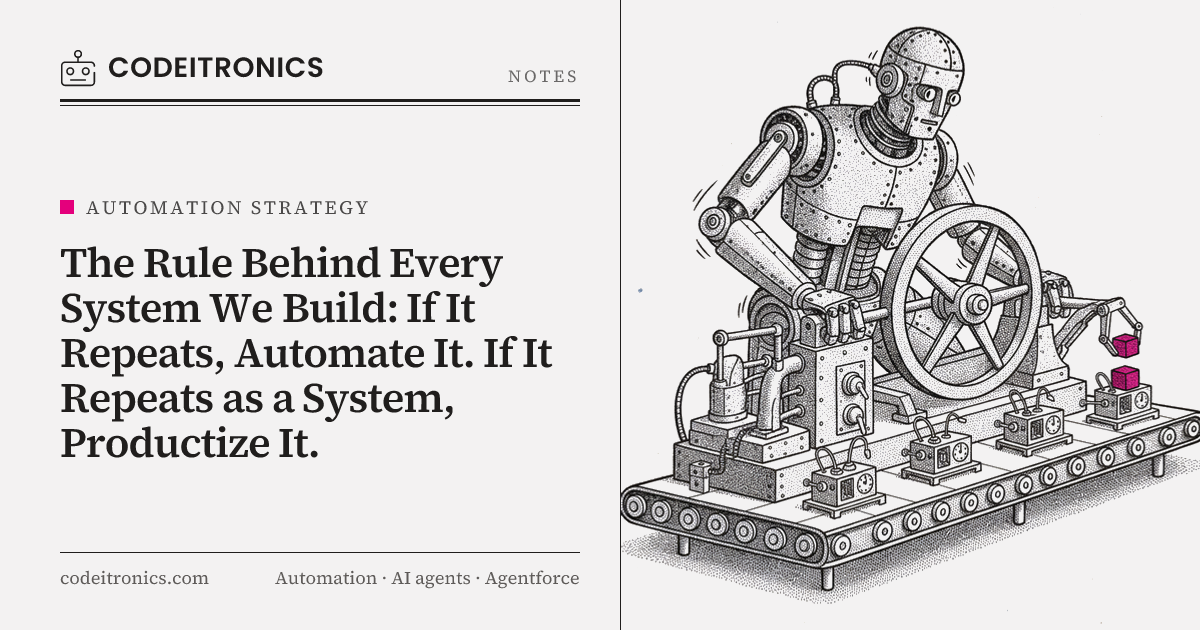
CodeITronics runs on one rule: if a problem repeats, it should become a system. If a system repeats, it should become a product. Every build we've written about in this series, from lead pipelines to database migrations to order automation, came out of that rule. This last post is about the rule itself: how I spot repetition, how I decide how far up the ladder a problem should climb, and what goes wrong when you climb too fast.
Where the rule came from
The most draining work usually isn't hard work. It's work you've already done. Rebuilding the same report. Re-researching the same kind of lead. Answering the same question in Slack for the fourth time that week. Hard problems were interesting. Repeated problems were just tax.
The instinct most engineers have is to automate the tax away immediately. But the timing matters as much as the automation. Automate too late and you burn hours. Automate too early and you build the wrong thing, then maintain it forever.
So the rule isn't really "automate everything." It's "notice what repeats, and move it up exactly as far as the repetition justifies." That's what "Build once. Automate forever." means to me. Build once, after you understand it. Not before.
How to spot repetition worth acting on
Repetition hides because each instance feels slightly different. Here's what I look for.
You're doing it from memory, not from thinking. If I can do a task while half-distracted because I know every step, that's a process, and processes can be written down.
The same question keeps arriving. When a team member asks "what were yesterday's numbers?" every morning, the question is a scheduled job waiting to exist.
Copy-paste between tools. Any time data moves between two systems through a human's clipboard, there's an integration missing.
You start new work by copying old work. When I begin a project by duplicating the last one and changing config, I'm maintaining a framework without admitting it.
People describe the same pain unprompted. When different teams or clients bring up the same frustration in their own words, the problem is bigger than one business.
A simple habit helps: when something annoys me, I write it down with a date. If the same item shows up three or four times, it gets my attention. Most items never repeat. The ones that do are almost always worth fixing.
The ladder from manual to product
I think about automation as a ladder with five rungs. Each rung costs more to build and maintain than the one below it, and each one is only worth it if the repetition demands it.
  5. Product    -- many customers, tenancy, billing, support
        ^
  4. System     -- durable service: state, retries, monitoring
        ^
  3. Workflow   -- orchestrated steps across tools (often n8n)
        ^
  2. Script     -- code that does one job when someone runs it
        ^
  1. Manual     -- a person doing it, ideally with a checklist
| Rung | Good for | Signal to climb | Ongoing cost |
|---|---|---|---|
| Manual | New, unclear, or rare tasks | Same steps every time | Human time |
| Script | Repeated tasks one person runs | Others need it, or it should run unattended | Low |
| Workflow | Multi-tool processes with simple logic | State, scale, or correctness pressure | Moderate |
| System | Core processes the business depends on | Same system needed by many teams or customers | Higher |
| Product | Problems many people share | (Top of the ladder) | Highest |
Two things matter about this ladder.
First, skipping rungs is expensive. Going straight from manual to system means you design a service around a process you've never written down. You'll encode guesses, not knowledge.
Second, the lower rungs aren't failures. A checklist that a person follows well is sometimes the right final answer. A script that runs weekly can be perfect for years. Climbing is a choice, not a destiny.
What the ladder looks like in our builds
Looking back across the case studies in this series, almost every build sits on a specific rung for a specific reason.
Consolidated KPI Reporting Bot (Manual to System). Founders were logging into five tools every day to check numbers. That's manual repetition in its purest form. The fix was a cron worker that polls Stripe, PostHog, and SQL and posts a daily Slack summary. The result: zero daily dashboard logins. It didn't need to be a product. It needed to stop being a habit.
AI Content Automation System (Manual to Workflow). The content process was a repeated sequence of gathering, drafting, formatting, filing, and notifying. It had simple logic and frequent changes, so it belonged on the workflow rung, built on n8n with LLMs, APIs, and Google Drive. It reduced manual effort by 80%. Pushing it further would have added cost without adding value.
Internal Ops Automation for a founder (Workflow). Notion, email, and task flows were unified into one operational layer with n8n. Another case where the workflow rung was the right place to stop.
B2B Lead Generation Pipeline (Manual to System). Sales teams were spending 60% of their day manually researching leads. That repetition was too heavy and too central for a simple workflow, so it became a system using Puppeteer, AI agents, the HubSpot API, and PostgreSQL. The result was a 4x increase in outbound volume, eliminated manual SDR research, and higher reply rates.
Customer Support AI Triage (System). Repeated ticket types became a triage system with OpenAI, the Zendesk API, vector embeddings, and the Vercel AI SDK, with 40% of tickets auto-resolved and instant response times.
Zero-Downtime Migration Engine (System). A one-time migration might seem like an odd fit for a rule about repetition, but the repetition was inside it: millions of rows, the same transform applied over and over, the same reconciliation checks run continuously. That needed a system, with Node streams, Redis queues, and Postgres on AWS RDS. It delivered 0 seconds of application downtime and 95% faster query speeds.
Micro-SaaS Workflow Builder (System to Product). This is the top rung. After building the same trigger-fetch-transform-deliver pattern across many automations, we abstracted it into reusable modules on Node.js, queues, APIs, and a database. That's the second half of the rule in action: the system itself repeated, so it became a product.
The pattern I see in this list is that the rung matched the problem. Nothing got built higher than it needed to be.
The cost of automating too early
This mistake is easy to make, and it usually looks like this.
You automate a process that's still changing. The first version of any process is a draft. Automate it and you freeze the draft. Every change after that is a code change, and the automation becomes the reason the process can't improve.
You encode edge cases you haven't seen yet. When you build before the repetition is clear, you guess at the exceptions. Some guesses are wrong, and the real exceptions show up later as bugs.
Maintenance outlives the value. Every automation needs credentials rotated, APIs updated, failures handled. A script that saves ten minutes a month but breaks every quarter isn't saving anything.
You hide the work instead of removing it. Sometimes the right fix isn't automation at all. It's deleting the step. An automated report that nobody reads is still a report nobody reads. The cheapest automation is the process you stop doing.
You productize your own context. Some tools work because they fit one business exactly. Turning them into a product strips out the context that made them useful.
The guard against all of this is patience. Do it manually a few times. Write the checklist. Then automate the checklist, not your idea of the process.
How I decide when to climb
When something keeps showing up on my list, I ask a short set of questions:
- Is this stable? If the steps changed in the last few runs, I stay on the current rung and keep documenting.
- What does it cost to keep doing it this way? Time, errors, and attention, honestly estimated.
- What does the next rung cost to build and to maintain? Maintenance is the number people forget.
- Who else has this problem? One person suggests a script. A team suggests a workflow or system. Many businesses suggest a product.
- Can I delete it instead? Always worth asking before building anything.
If the answers point up, I climb one rung, not three. Then I let the new rung prove itself before considering the next.
Key Takeaways
- Repetition is the signal. Notice it deliberately, write it down, and act when it keeps coming back.
- Think in rungs: manual, script, workflow, system, product. Each one costs more and is only worth it when repetition demands it.
- Every CodeITronics build in this series sits on the rung that matched its problem, from a daily KPI bot to a micro-SaaS product.
- Automating too early freezes drafts, encodes guesses, and creates maintenance that outlives the value.
- Climb one rung at a time, and always ask whether the step can be deleted instead.
FAQs
What does "If it repeats as a system, productize it" mean?
When you find yourself building the same system for different teams or clients, the system has become a pattern. That pattern may be worth turning into a reusable product.
How many times should something repeat before I automate it?
There's no magic number. I wait until the steps are stable and I can write them down without changing them. For me that's often three or four repeats.
Should every automation become a product?
No. Most shouldn't. Products need multi-tenancy, billing, onboarding, and support. Many problems are best solved permanently at the script, workflow, or system level.
Is it ever right to skip rungs?
Occasionally, when the process is already well understood and documented elsewhere. Even then, a short manual or workflow phase usually reveals edge cases worth knowing.
What's the first step if I want to apply this?
Keep a dated list of the tasks that annoy you. Revisit it every couple of weeks. The items that keep appearing are your automation roadmap.
Working on Something Similar
If you've got a process that keeps coming back and you're not sure which rung it belongs on, I'm always happy to think it through with founders and teams. You can browse the builds from this series on our work page, see what we offer on the services page, or reach out directly.
Letters to the editor
No letters yet. Questions and counterpoints are welcome.