AI Content Automation System
The content system we run CodeITronics on: blog drafts, social posts for six platforms, a weekly newsletter and an n8n planner for ten formats, with a person approving everything.
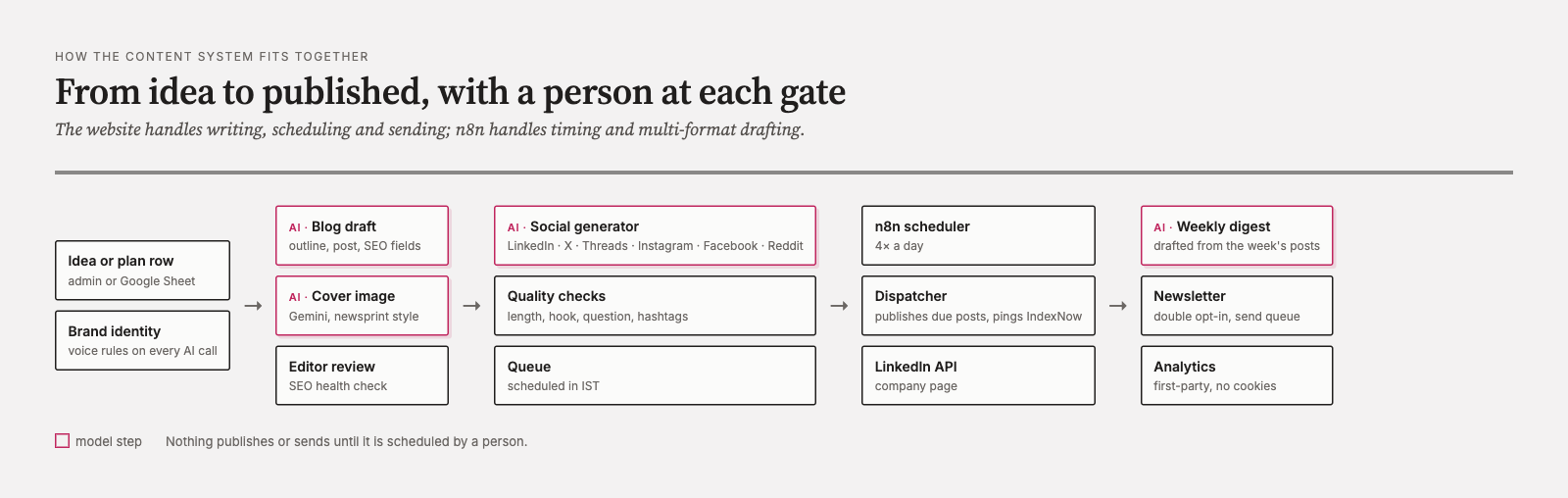
Turning each idea into a blog post, six platform-specific social posts and a newsletter, every week, without the voice drifting, took more time than writing the idea down.
A website-native content system (brand voice, blog drafting, social generator, queue, newsletter) plus n8n workflows for scheduling and multi-format planning. Everything is drafted and checked automatically; nothing goes out until a person schedules it.
- 75 LinkedIn posts written and scheduled for the CodeITronics page
- A 30-part AI Systems blog series written and scheduled
- Scheduler checks for due posts 4 times a day
- Both n8n workflows open-sourced as client templates
Why we built it
Our bottleneck wasn't ideas. It was turning each idea into a blog post, then into six differently shaped social posts, then into a newsletter, every week, without the voice drifting. So we built the system we now run our own content on, and that we set up for clients.
What's in it
- Brand identity first. One page defines who we are, who we write for, how we sound and the phrases we never use. It's sent with every AI request: blog drafts, rewrites, SEO fixes, social posts and digests.
- Blog drafting. Topic → outline → post → SEO fields → cover image (Gemini, in the site's newsprint style). The editor scores SEO health before publishing.
- Social generator. One post becomes native versions for LinkedIn, X, Threads, Instagram, Facebook and Reddit, each checked against the platform's rules: length, hook, a closing question, hashtags.
- Queue and scheduler. Posts are scheduled in IST. An n8n workflow calls the site's dispatcher four times a day; it publishes due posts (LinkedIn company page by API), pings IndexNow for new blog posts, and processes the newsletter queue.
- Newsletter. Double opt-in, a weekly digest drafted from the week's posts, and a send queue that can't double-send.
- Multi-platform planner (n8n). For calendar-driven teams: one plan row becomes ten drafts, each validated and scored for publish-readiness, rewritten if it falls short, and delivered as one brief to Notion and email.
What we've produced with it
75 LinkedIn posts for the CodeITronics page, written and scheduled; a 30-part AI Systems series on the blog, written and scheduled to publish daily. None of them goes out until it has been scheduled from the queue.
The client version
The planner workflow is open source as a template: brand, handle and voice come from a Brand Memory sheet, so a new client needs no prompt edits. Its seed data is a fictional company, Brightline Analytics, so you can run it end to end before connecting your own brand. The 12-in-1 planner, which writes twelve formats into Google Docs, is open source too.
Decisions we'd make again
Draft everything, publish nothing automatically. AI is good at first drafts and bad at knowing when something is wrong. Scoring drafts and asking a person to approve them keeps the speed without the risk.
Voice in one place. Putting brand rules in a single page that every prompt inherits means one edit changes the voice everywhere, instead of hunting through a dozen prompts.
Boring scheduling. A simple n8n schedule calling one authenticated endpoint is easier to reason about, and cheaper to host, than a long-running worker.
Have a workflow like this?
If it keeps repeating, it can become a system. Tell us what it looks like today.
Start a project