Yesterday we defined an AI agent as a goal-driven system that thinks, acts, and observes in a loop. Today we turn that definition into a blueprint: the components of agent architecture, how they connect, and what a reasonable stack looks like. If Day 1 was the "what", this is the "how it is put together".
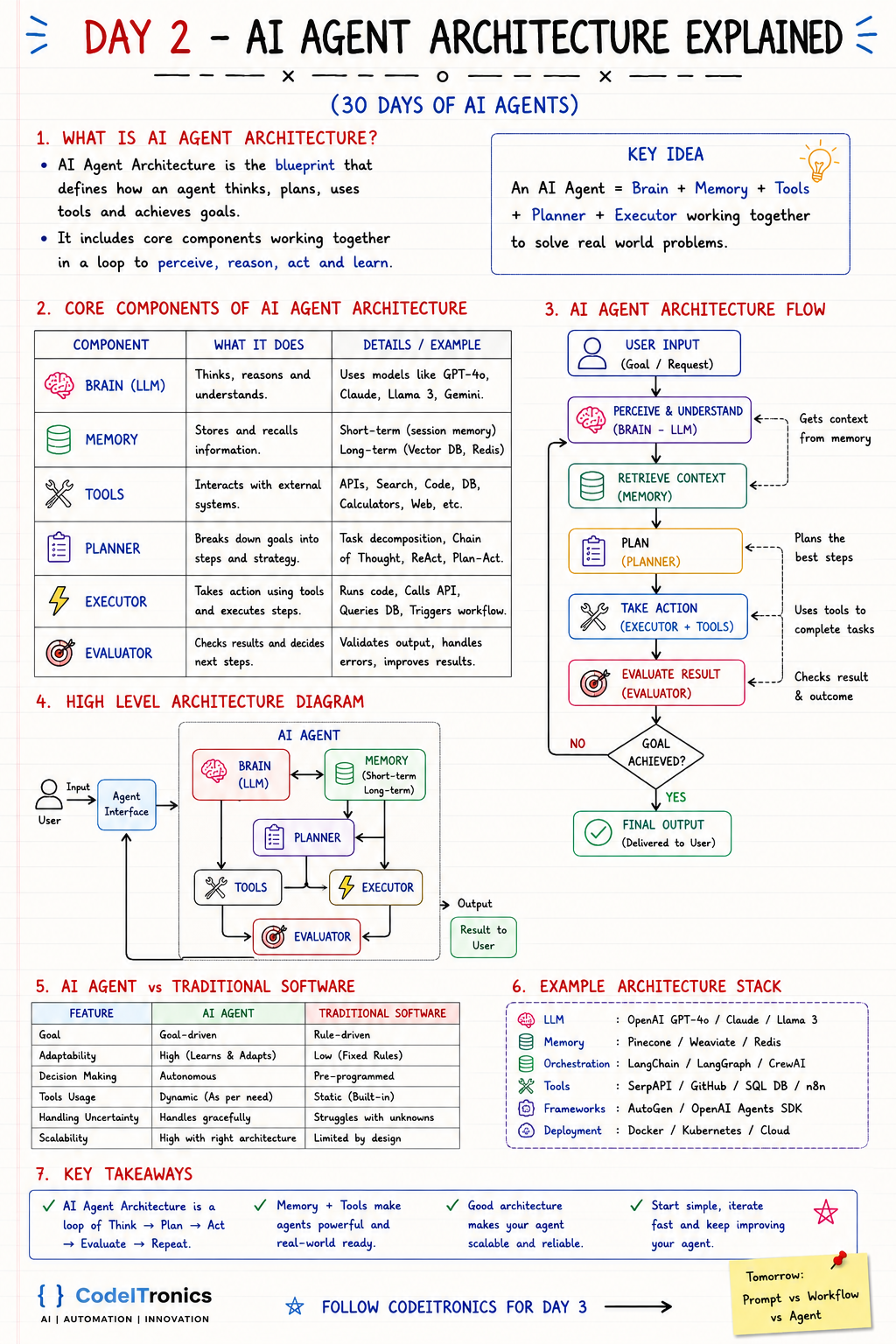
Save this sheet. The rest of this note walks through it section by section.
What Agent Architecture Means
Agent architecture is the blueprint that defines how an agent thinks, plans, uses tools, and reaches a goal. The key idea on the sheet is worth memorizing:
Agent = Brain + Memory + Tools + Planner + Executor, working together in a loop to perceive, reason, act, and learn.
Architecture matters because agents fail in boring ways. They lose context, call the wrong tool, retry forever, or return confident nonsense. Almost every one of those failures traces back to a missing or blurry component, not to the model being "not smart enough".
The Six Core Components
| Component | What it does | Details |
|---|---|---|
| Brain (LLM) | Understands the request and reasons about next steps | GPT-4o, Claude, Llama 3, Gemini |
| Memory | Stores and recalls information | Short-term session history, long-term store in a vector DB or Redis |
| Tools | Interact with external systems | APIs, search, code, databases, calculators, web |
| Planner | Breaks goals into steps and strategy | Task decomposition, chain of thought, ReAct, plan-and-execute |
| Executor | Takes action and runs the steps | Runs code, calls APIs, queries databases, triggers workflows |
| Evaluator | Checks results and decides what happens next | Validates output, handles errors, decides to retry or stop |
The evaluator is the one teams skip, and it is the one that separates a demo from a system. Without it, the agent has no principled way to say "this is good enough" or "this is wrong, try again".
The Architecture Flow
User input (goal)
  -> Perceive and understand (LLM)
  -> Retrieve context (memory)
  -> Plan (planner)
  -> Take action (executor + tools)
  -> Evaluate result (evaluator)
       -> goal achieved?  no  -> back to perceive, with new context
                          yes -> final output to the user
Two details matter here. First, memory is read before planning, so the plan reflects what the agent already knows. Second, the "goal achieved?" check is explicit. It should be a real function with criteria, not the model's vibe.
A good evaluator starts cheap and deterministic, then escalates:
def evaluate(output: dict) -> tuple[bool, str]:
    # 1. Cheap structural checks first
    if not output.get("answer"):
        return False, "empty answer"
    if not output.get("sources"):
        return False, "no sources cited"
    # 2. Business rules
    if len(output["answer"]) > 4000:
        return False, "answer too long for the channel"
    # 3. Only then, optionally, an LLM-as-judge check for quality
    return True, "ok"
The reason string goes back into the loop as feedback, so the next attempt knows what to fix.
The High-Level Diagram
On the sheet, the user talks to an agent interface, not directly to the model. That interface is where you put authentication, rate limits, input validation, and logging. Inside the agent, the brain talks to memory, the planner hands steps to the executor, the executor uses tools, and the evaluator checks the outcome before anything goes back to the user.
Keeping these as separate modules pays off quickly. You can swap the model without touching tools, replace the vector store without touching the planner, and test the executor without paying for LLM calls.
Agent vs Traditional Software
| Feature | AI agent | Traditional software |
|---|---|---|
| Goal | Goal-driven | Rule-driven |
| Adaptability | Adapts to new inputs | Fixed rules |
| Decision making | Autonomous | Pre-programmed |
| Tool use | Dynamic, as needed | Static, built in |
| Uncertainty | Handles ambiguity gracefully | Struggles with unknowns |
| Scalability | High with the right architecture | Limited by design |
In practice the best agents are both. A deterministic shell (interface, tools, validation, permissions) wraps a probabilistic core (the model). Treat the model like a talented new hire: you let it decide, but you do not give it the production database password.
An Example Stack
| Layer | Common options | Notes |
|---|---|---|
| LLM | OpenAI GPT-4o, Claude, Llama 3 | Pick per task; a smaller model often handles routing |
| Memory | Pinecone, Weaviate, Redis | Postgres with pgvector is a solid default if you already run Postgres |
| Orchestration | LangChain, LangGraph, CrewAI | Covered on Days 9, 10, and 14 |
| Tools | SerpAPI, GitHub, SQL databases, n8n | Wrap each one with input validation |
| Frameworks | AutoGen, OpenAI Agents SDK | Useful for multi-agent conversations and handoffs |
| Deployment | Docker, Kubernetes, managed cloud | Agents are long-running jobs; plan for timeouts and queues |
You do not need every layer on day one. A model API, a Postgres table for memory, and three well-described tools will take you surprisingly far.
Design Principles and Patterns
The principles that hold up in real builds:
- Goal-oriented. Every run has a clear definition of done.
- Modular. Components talk through small interfaces.
- Memory-aware. The agent knows what to remember and what to forget.
- Observable. Every thought, tool call, and result is logged with a run ID.
- Bounded. Step limits, cost limits, and timeouts on every loop.
- Secure. Least-privilege credentials per tool.
And the patterns you will meet later in the series: ReAct (reason, act, observe), plan-and-execute (plan everything first, then run), reflection (critique and revise), multi-agent, and hierarchical (a manager agent delegating to workers).
Key Takeaways
- Agent architecture is a loop of think, plan, act, evaluate, repeat.
- Six components: brain, memory, tools, planner, executor, evaluator.
- The evaluator is what turns a demo into a system. Make "goal achieved" an explicit check.
- Wrap the probabilistic model in a deterministic shell of validation and permissions.
- Start with a small stack and iterate; modular design lets you swap parts later.
FAQs
Do I need a separate planner component?
Not always. For short tasks, the model can plan inline with ReAct-style reasoning. Add an explicit planning step when tasks have many steps or when you need to show or approve the plan before execution.
What should the evaluator check first?
Structure and rules: required fields, valid formats, citations present, limits respected. These are cheap and reliable. Use an LLM judge only for qualities that code cannot check.
Can one model play every role?
Yes, and many agents do. Splitting roles across models is an optimization, usually a small fast model for routing and a stronger one for reasoning.
Up Next
Day 3 is Prompt vs Workflow vs AI Agent: three levels of autonomy, when each one is the right tool, and why the cheapest level that solves the problem usually wins. It is the decision you should make before writing any agent code. If you want help designing an agent architecture for your own use case, reach out.

Letters to the editor
No letters yet. Questions and counterpoints are welcome.