Yesterday we took agents into production with queues, backpressure, failure handling, and cost controls. That was the last technical building block. Day 30 closes the series: a look back at the thirty days, an honest look at where agents are heading, and what that means for the people building them.
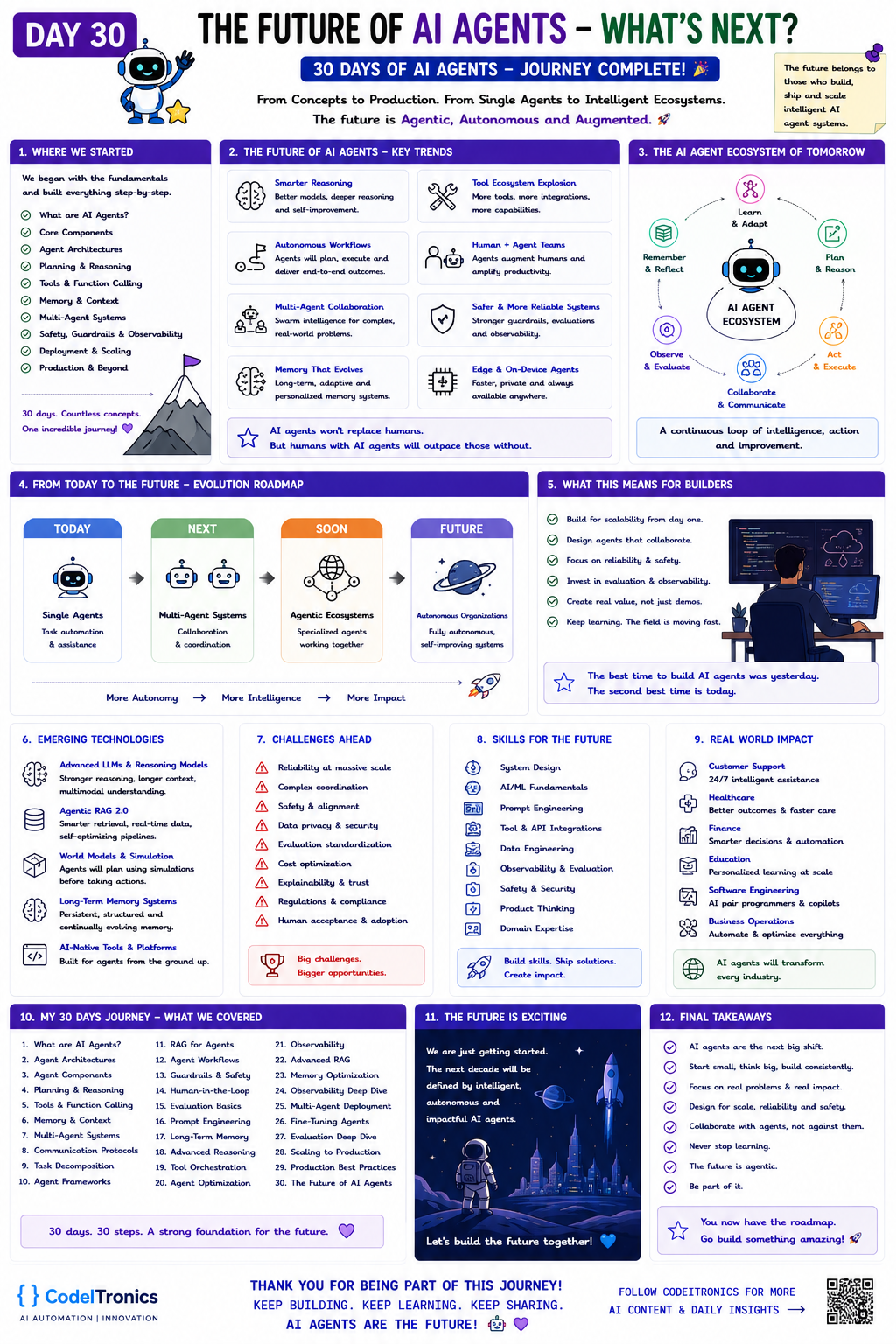
Save this sheet. The rest of this note walks through it section by section.
Thirty days in one view
We started with the fundamentals and built up one layer at a time, from concepts to production and from single agents to systems of agents.
| Days | Theme | Topics |
|---|---|---|
| 1 to 7 | Foundations | What an agent is, architecture, prompts vs workflows vs agents, single vs multi-agent, memory, the agent lifecycle, building your first agent |
| 8 to 14 | Frameworks and protocols | MCP, LangChain, CrewAI, AutoGen, n8n with agents, vector databases, LangGraph |
| 15 to 20 | Core capabilities | RAG, agent memory, multi-agent systems, tools, planning and reasoning, collaboration patterns |
| 21 to 25 | Quality and trust | Evaluation, safety and guardrails, advanced RAG, memory optimization, observability |
| 26 to 29 | Production | Multi-agent deployment, fine-tuning, evaluating multi-agent systems, scaling to production |
If there is one thread through all of it: the model is the smallest part of a working agent. Most of the engineering lives in the tools, memory, retrieval, guardrails, evaluation, and infrastructure around it.
Trends worth watching
The sheet lists eight trends. Here is how I read each one, without pretending to know timelines.
- Smarter reasoning. Models that plan and check their own work are improving quickly, which reduces how much scaffolding you write by hand.
- Autonomous workflows. Agents increasingly own outcomes end to end rather than single steps.
- Multi-agent collaboration. Specialized agents coordinating on bigger problems. As Day 28 showed, the hard part is the coordination, not the agents.
- Memory that evolves. Long-term, adaptive, personalized memory, with the cost and privacy questions from Day 24 attached.
- Tool ecosystem growth. Standards like MCP make it easier to give agents many integrations; least privilege matters more as that list grows.
- Human and agent teams. Agents that augment people rather than replace them, with humans approving high-impact decisions.
- Safer, more reliable systems. Stronger guardrails, evaluations, and observability becoming standard rather than optional.
- Edge and on-device agents. Smaller models running locally for speed and privacy.
The sheet's line is worth keeping: AI agents won't replace humans, but humans with AI agents will outpace those without.
The agent loop of tomorrow
The sheet draws the agent ecosystem as a continuous loop: plan and reason, act and execute, collaborate and communicate, observe and evaluate, remember and reflect, learn and adapt.
Every step maps to something we built in this series. Planning was Day 19. Acting was tools and MCP. Collaboration was Days 17 and 20. Observing and evaluating were Days 21, 25, and 28. Remembering was Days 5, 16, and 24. Learning and adapting was fine-tuning and feedback loops. The future does not need a new architecture. It needs these pieces to get more reliable and work together more tightly.
From single agents to agentic ecosystems
The sheet's roadmap has four stages:
Today   -> Single agents        (task automation and assistance)
Next    -> Multi-agent systems  (collaboration and coordination)
Soon    -> Agentic ecosystems   (specialized agents working together)
Future  -> Autonomous orgs      (largely self-improving systems)
More autonomy, more intelligence, more impact. Treat the later stages as a direction, not a schedule. Most organizations are still getting single agents into reliable production, and that is where most of the value is today.
What this means for builders
The sheet's advice is practical and I agree with every line of it:
- Build for scalability from day one. Stateless agents, external state, queues.
- Design agents that collaborate. Clear roles and structured handoffs.
- Focus on reliability and safety. Guardrails in code, humans on high-impact actions.
- Invest in evaluation and observability. You cannot improve what you cannot see or measure.
- Create real value, not just demos. Pick a repeated, costly task and own its outcome.
- Keep learning. The field moves fast; the fundamentals in this series move slowly.
The emerging technologies on the sheet, including advanced reasoning models, agentic RAG, world models and simulation, long-term memory systems, and AI-native tools and platforms, will change the components. They will not change the discipline of defining a task, measuring it, and engineering the system around the model.
Challenges that remain
The open problems on the sheet are real: reliability at massive scale, complex coordination, safety and alignment, data privacy and security, evaluation standardization, cost optimization, explainability and trust, regulation and compliance, and human acceptance and adoption.
The last one is underrated. An agent that works but that nobody trusts does not get used. Transparency about what the agent can and cannot do, good escalation paths, and visible audit trails do as much for adoption as accuracy does.
Skills that will matter
The sheet's list: system design, AI and ML fundamentals, prompt engineering, tool and API integrations, data engineering, observability and evaluation, safety and security, product thinking, and domain expertise.
Notice how much of that is classic software engineering. Agents reward people who can design systems, integrate APIs, model data, and reason about failure. Domain expertise and product thinking decide which problems are worth automating. The real-world impact on the sheet spans customer support, healthcare, finance, education, software engineering, and business operations, and in each one the winners will be teams that pair an agent with deep knowledge of the work.
Key Takeaways
- The model is the smallest part of a working agent; the system around it is the job.
- Reliability, safety, evaluation, and observability turn demos into products.
- Multi-agent and ecosystem stages are a direction, not a deadline; single agents done well deliver most value today.
- Classic engineering skills plus domain expertise are the durable advantage.
- Start small, think big, and build consistently.
FAQs
Where should a team new to agents start?
Pick one repeated, well-defined task, build a single agent with a few tools, add evaluation and observability, and expand from there.
Will multi-agent systems replace single agents?
No. Use multiple agents when roles, tools, or context genuinely need separating. Many problems are best solved by one well-built agent.
Is it too late to start building agents?
No. Most organizations are still early, and the fundamentals in this series apply regardless of which models come next.
Up Next
That is a wrap on 30 Days of AI Agents. Thirty sheets took us from what an agent is to evaluating, securing, deploying, and scaling systems of agents. Thank you for reading, saving, and sharing along the way.
Next, we put it all to work. 30 Days of Building AI Systems starts with the next post: thirty complete systems, each with its architecture, components, workflow, and stack. Day 1 is the AI Research Assistant System, which takes a question, searches the web, retrieves and synthesizes sources, and returns a cited research report. If you want one of these systems built for your team, get in touch.
Letters to the editor
No letters yet. Questions and counterpoints are welcome.